
A clean room that moves with the patient.
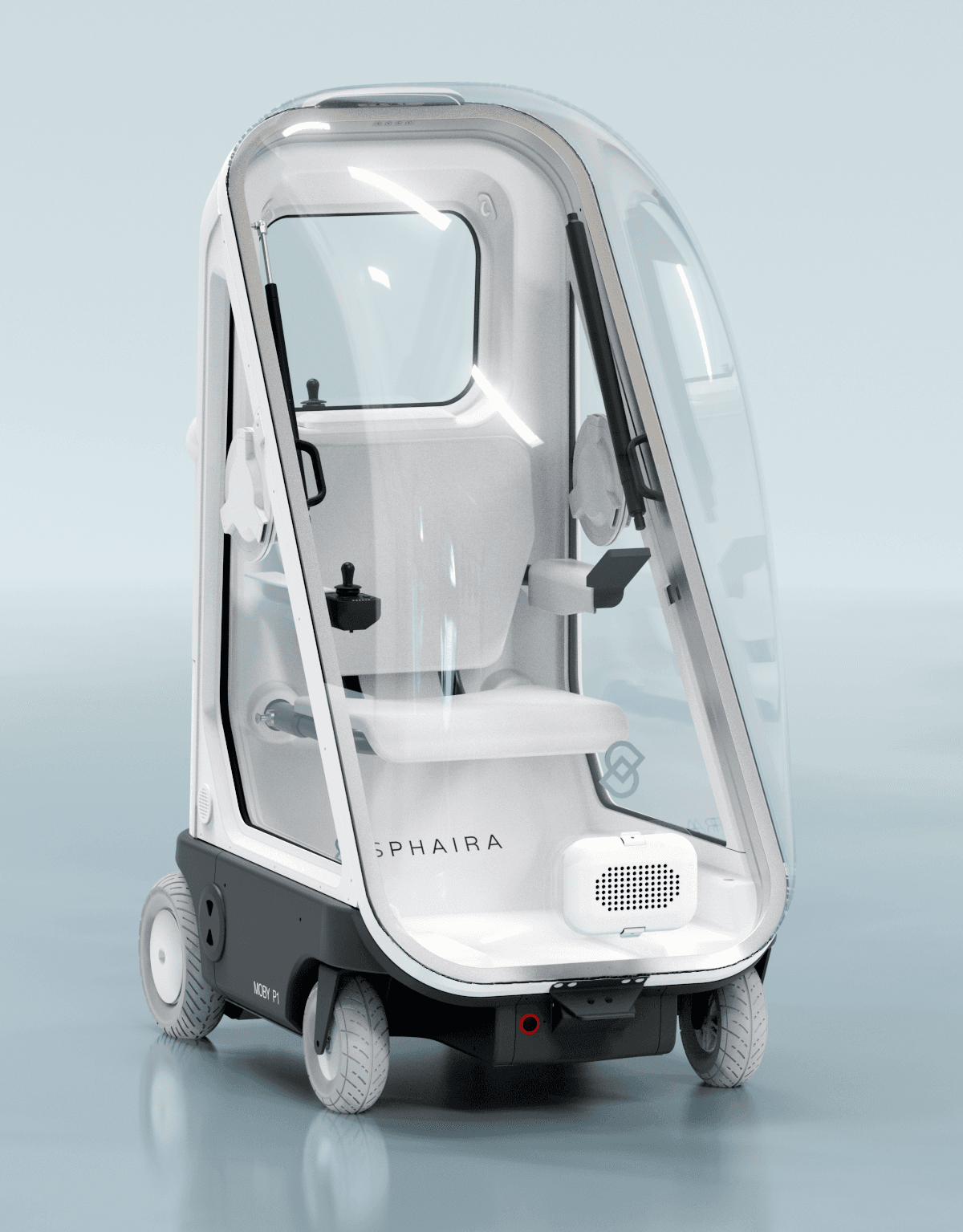
We designed MOBY around a simple idea: protection should move with the patient.
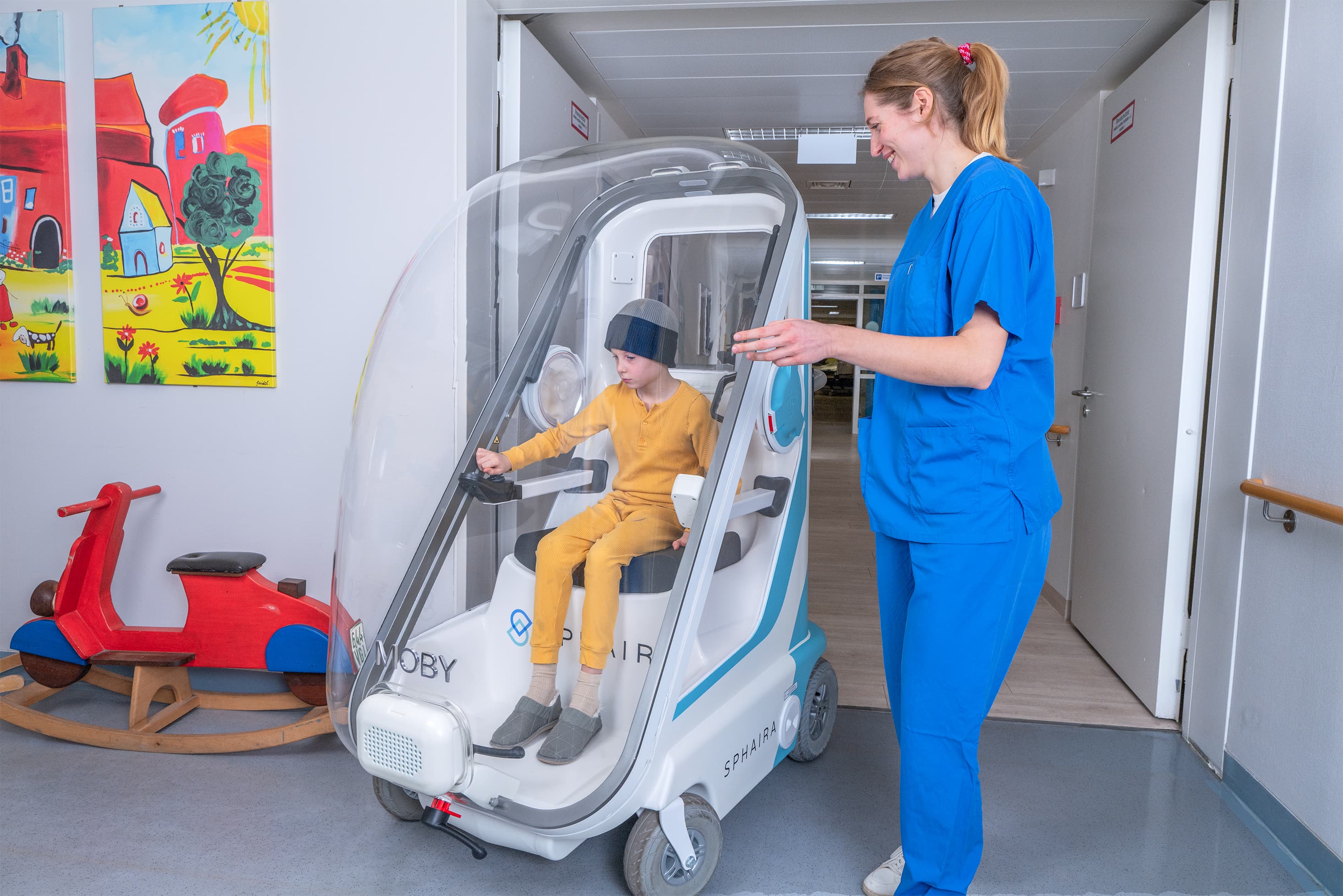
Two shells come together around a person to create a filtered, pressure-controlled environment. A mobile protective pod that lets patients leave their room, welcome visitors and stay connected to the people around them.
To see and be seen. To touch, to talk, to move. And to experience the world beyond the room.
We thought about the people caring for them, too. So we made MOBY simple to operate. Quick to clean. And ready for everyday care.
Two directions of protection
Two precisely fitting, interlocking shells form the seal. Which way the air moves through it is a choice:
Positive pressure
Filtered air flows in, room air stays out. The person inside is protected.
Negative pressure
Air flows in and is filtered before it leaves. Everyone outside is protected.
We have designed the filter and ventilation system for easy and safe assembly. Staff switch between modes in ten steps, without tools. Sensors detect the active mode automatically and display it on the device.
Who sits inside and who is protected in each mode: see Indications & Use Cases.
Cleaner than the air in an operating room. On the move.
In positive-pressure mode, the air inside MOBY meets ISO Class 3 (DIN EN ISO 14644-1), cleaner than the Class 5 required of operating rooms with the highest hygiene requirements.
After a hundredfold particle load, the cabin returns to cleanroom conditions within minutes. In negative-pressure mode, the exhaust air is filtered to the same standard and the cabin was shown to be leak-tight.
Independently tested by the Deutsche Gesellschaft für Klimahygiene, 2024.
ISO Class 3
Operating rooms of the highest class: ISO Class 5.
Built for a normal day, under full protection.
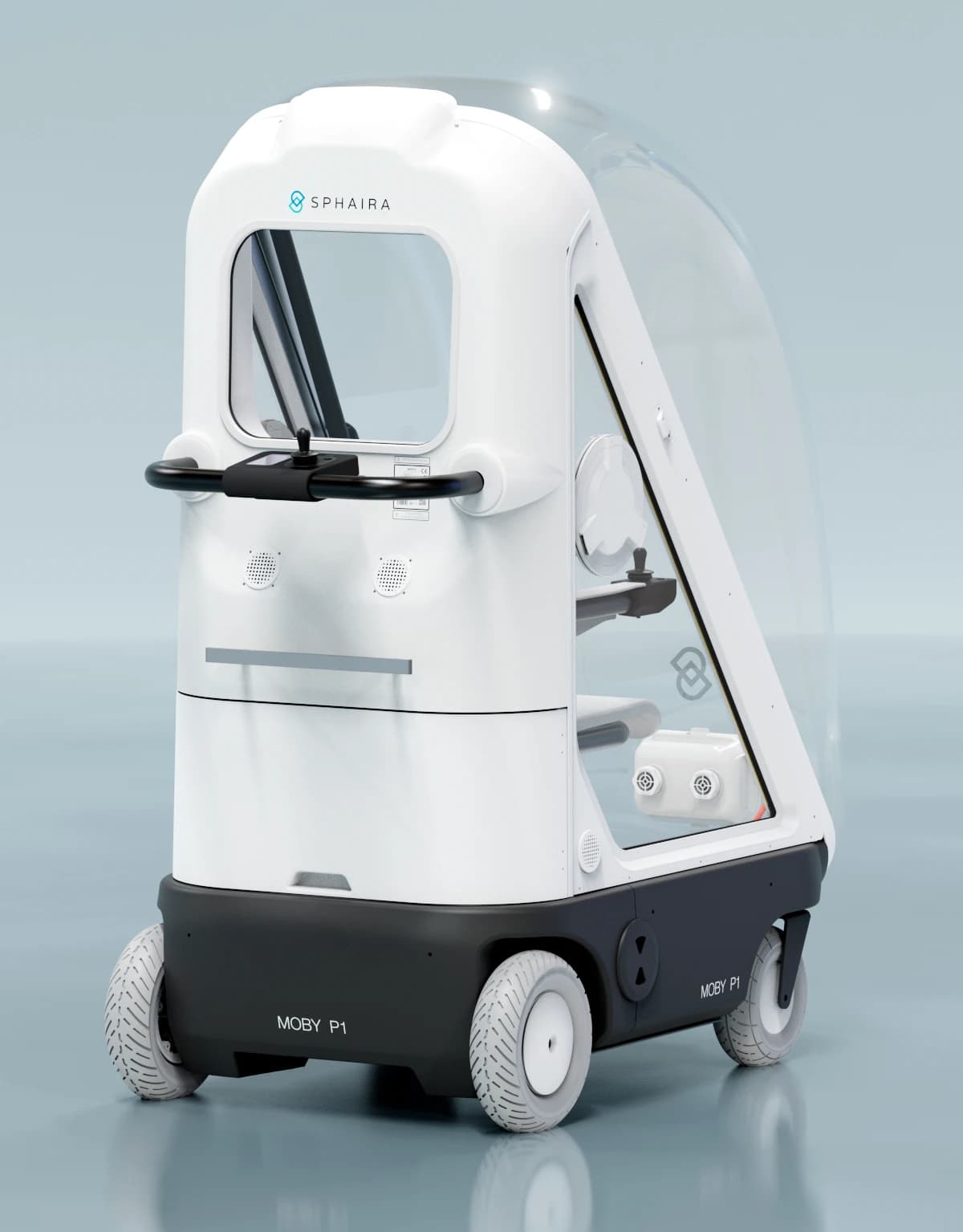
MOBY is designed so the patient experiences the world almost normally and stays protected the whole time. It is also designed for the staff: quick to clean and disinfect between uses.
Protection
Everything that keeps the air clean and tells you it is.
Filtration
Clean air, in every mode.
Four-stage filtration, passed in the same order in both modes: a G3 pre-filter, two H13 HEPA filters in series, then a D67 fine filter that retains fibers in the rare case that a filter sheds them. All air entering or leaving the pod passes through all four stages.
Continuous monitoring
Protected at all times, with an alarm the moment anything changes.
A microcomputer measures the pressure inside the cabin continuously and holds it at 50 Pa above or below the surroundings, depending on the mode. Any deviation triggers an audible and visual alarm.
Door and emergency provisions
Easy entry through an electrically opening door.
The door opens and closes electrically, from inside or outside. Should power or electronics fail, a mechanical emergency release opens it: a pull ring inside, a button outside. With ventilation off and the canopy closed, CO2 stays below the German workplace limit for 15 minutes, measured with an adult. For the case that the canopy has to be opened in an emergency, an FFP2 mask is on board.
Connection
Everything that lets the patient see, hear and touch the people around them.
Canopy
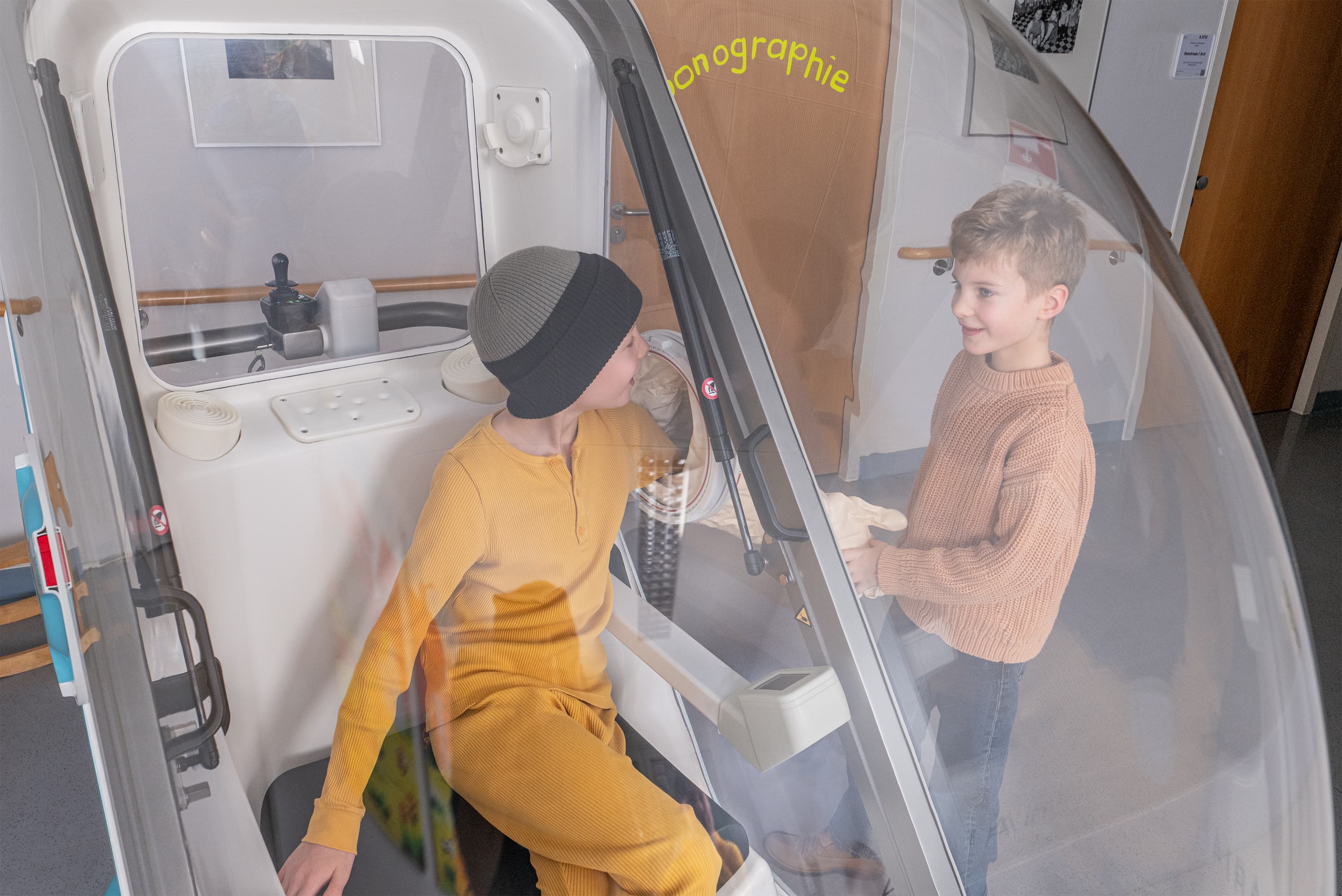
The patient sees the corridor, the garden, the family, and is seen.
A large, transparent hood with 360° visibility, made from cast acrylic (PMMA GS) and formed at the largest size that is technically possible.
Glove ports
A hand can be held, from either side.
A glove port for direct touch, inside and out, without breaking the barrier. Laboratory-grade gloves, reusable, quick to replace.
Communication
A conversation at normal volume, with the canopy closed.
Full-duplex digital intercom with seven microphones and four speakers: both sides can speak at once, with less than 50 ms delay.
Mobility and care
Everything that keeps treatment and movement going.
Drive and control
The patient can drive, and staff stay in control.
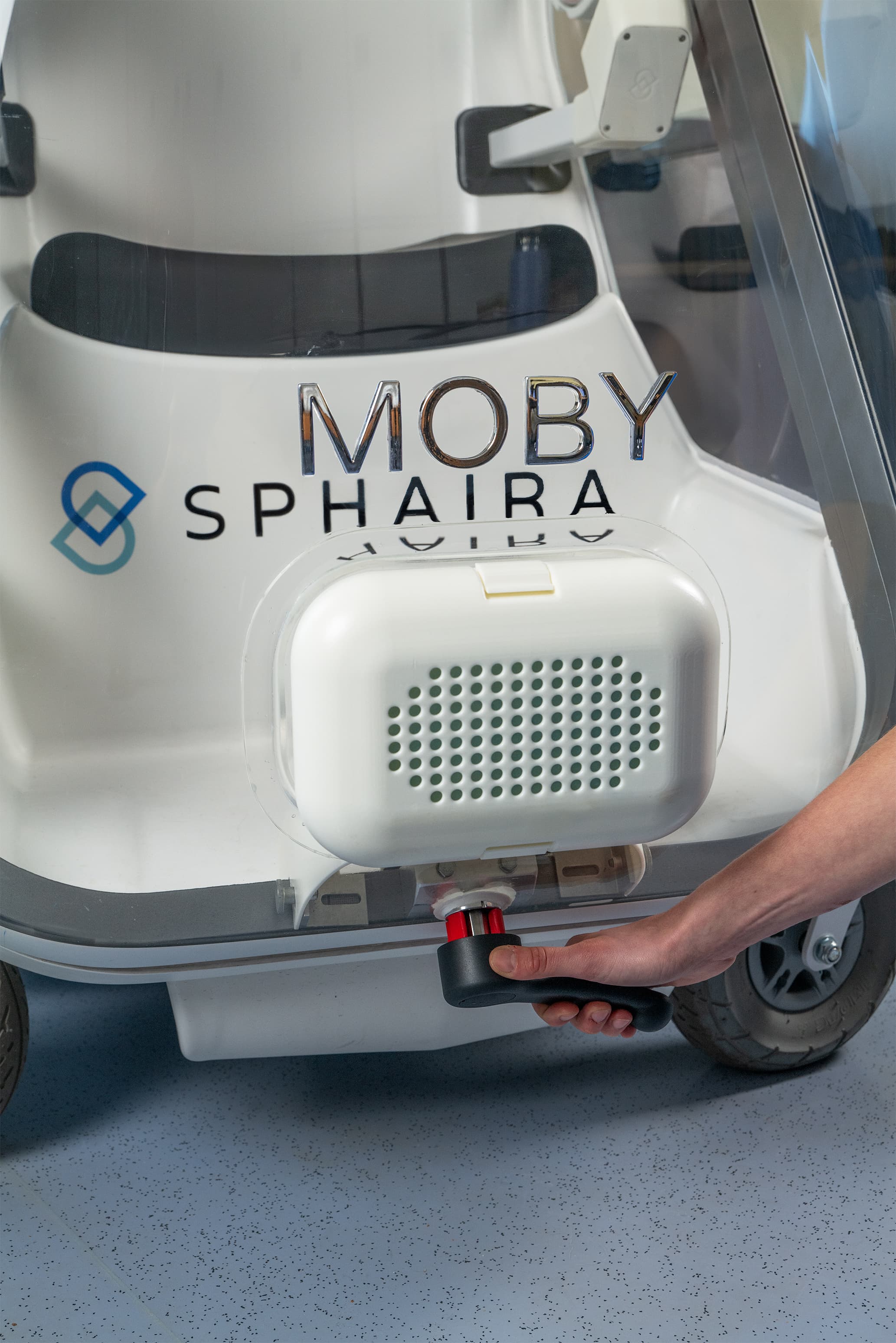
Electric drive, 2 × 200 W with electromagnetic brake, up to 6 km/h (3.7 mph). Internal joystick and touchscreen for the patient; master joystick and touchscreen at the rear for the accompanying nurse or porter. Without power, the brakes stay fully engaged. A manual release lets the operator push MOBY by hand: open the latches on both sides, then turn the brake-release switches.
Access port and medical rail
Treatment continues when the patient leaves the room.
A port in the canopy frame for lines and cables, so infusions, monitoring and oxygen stay connected. A DIN EN ISO 19054 standard rail on the back carries pumps, monitors and other devices.
Built into the routine, not around it.
How MOBY fits into your ward's workflows: from transfer and training to cleaning, filters, power and space.
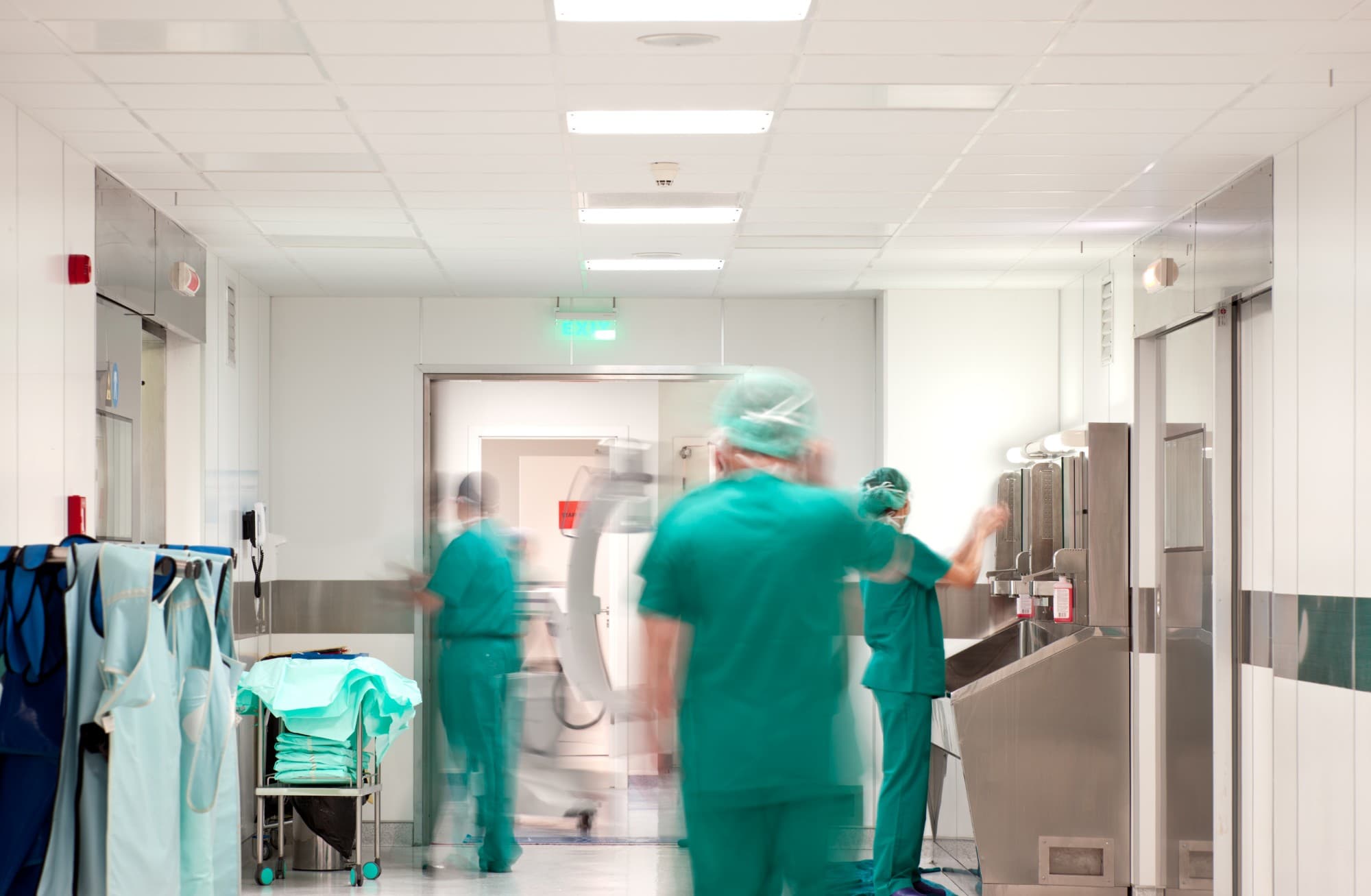
The door opens electrically; the patient enters and leaves from the front, with help from one or both sides if needed, within minutes. Infusion lines stay connected through the access port, so no disconnecting and reconnecting.
One introductory training each for nursing staff, for cleaning staff and for the patient or visitor, then MOBY is in routine use.
Surface disinfection with standard hospital disinfectants, by the hospital's own cleaning staff, in under 45 minutes after training. Canopy closed and ventilation running, MOBY is ready for the next patient shortly afterwards.
Pre-filter weekly, HEPA elements on a longer schedule, and a full filter change whenever the mode is switched.
About 34 hours of ventilation per charge when not driving (calculated), six to seven hours to recharge from a standard socket. The display shows the battery level.
MOBY is sized for hospital buildings: it passes through standard doors and fits into standard elevators, with a footprint of 153 by 84 cm (60 by 33 in). It turns around in a corridor 170 cm (67 in) wide and, with the canopy open, needs a ceiling height of 247 cm (97 in). Between uses it parks wherever a wheelchair would. At Charité it lives in the corridor outside the isolation unit.
Predictable running costs.
MOBY is designed for a service life of ten years. Filters and consumables are replaced on a defined schedule so protection stays constant over the life of the device. Filter packs are sized to your usage. Maintenance contracts cover inspection and safety checks. Our clinical team will walk you through the schedule for your unit.
Specifications
153 × 84 × 178 cm (60 × 33 × 70 in)
247 cm (97 in)
U-turn in a 170 cm (67 in) corridor
235 kg (518 lb)
up to 150 kg (331 lb)
140 to 200 cm (4 ft 7 in to 6 ft 7 in), from age 3
2 × 200 W electric, electromagnetic brake, up to 6 km/h (3.7 mph)
max. 6 % / up to 5 cm (2 in)
AGM, 24 V, 40 Ah
approx. 34 h ventilating, not driving (calculated) / approx. 6–7 h, standard socket
Positive and negative pressure, ±50 Pa
G3 pre-filter, 2 × H13 HEPA (EN 1822), D67 fine filter
up to 430 l/min (15 cfm)
Intended use, as declared.
MOBY is a CE-marked medical device, Class I, under EU MDR 2017/745. Basic UDI-DI: 42700045162MOBYHP. Electrical and drive safety tested by an independent laboratory against the applicable requirements of EN 60601-1, EN 12184 and ISO 7176-14.
The device is a powered, mobile clean room designed to function as a mobile protective isolation unit, preventing particulate contamination of the enclosed patient from the external environment while allowing mobility in a seated position. It facilitates social interaction through tactile and visual connectivity.
Additionally, the device safeguards the surrounding environment from potential particulate contamination by the passenger while maintaining their mobility.